Helping families push through health bureaucratic barriers: Say hi to Carey

“Insurance has bots to deny us, providers have bots to screen us, and now Carey is here to represent us.”
When most people think about healthcare navigation, they think of scheduling follow-ups, filling prescriptions, confirming insurance coverage, and so on.
It’s the invisible work of care navigation, tedious and time-consuming, but essential. And it stacks up fast, especially for working families managing care across generations.
“The problem is, the healthcare system hands families’ next steps, and they are inundated with administrative burden,” said Shantenu Agarwal, CEO, Co-Founder, at Carey. “You go to the doctor’s office, they hand you a piece of paper, and then you get a list of five things you have to do next.”
Carey is being built to address this gap.
As Shantenu describes it, the field is getting better at making information accessible, from records to resources to conversational AI, but action is still the missing layer.
“You could go talk to your favorite AI and learn about something, which is super cool,” he said. “But then there’s now what? How do I do it? And when do I find time to do it?”
That “now what” is where navigation breaks down in real life. In other words, the pain point isn’t a lack of information. It’s a lack of infrastructure to support patients and families getting to the next step in care, often times while dealing with difficult diagnoses.
Shantenu describes Carey as the “ concierge” that actually helps families get things done. It’s designed to reduce the cognitive load that families carry every day by taking the small but critical tasks that keep care moving and completing them on families’ behalf.
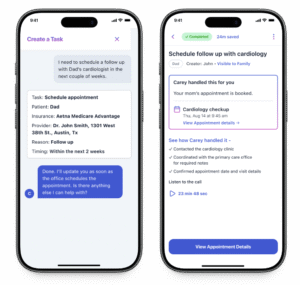
This is what Carey is designed to do: call the provider, call the pharmacy, call the health plan, stay on hold, confirm details, document answers, and report back—so families don’t have to lose hours disrupting work or other commitments waiting on hold just to move care forward.
How it works
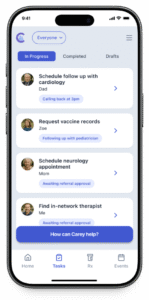
Carey’s model is simple. Families tell Carey what they need, such as scheduling an appointment or managing prescription refills, and Carey tak
es action. That action often looks like taking on the invisible work everyone must do if care is going to happen on time.
One family came to Carey with an urgent need to schedule an imaging appointment for diagnosis. Their provider could only find an appointment four weeks out, with anxiety for the family only building by the day. Carey called local imaging centers and found an earlier opening the following week, saving three weeks of waiting, emotional turmoil, and multiple hours of phone calls and scheduling.
And for families managing chronic conditions at scale, the burden multiplies. Shantenu described a newly onboarded mother of five, with three children managing chronic conditions and “a list of 25 prescriptions” across the family. Carey has stepped in to support the mother, following up on prescriptions refills and coordinating follow-up care as necessary so that nothing is forgotten. This mom knows she can’t be there forever, and with college looming in the future, she is excited to have a tool to support her daughter from afar.
Building the next generation health advocate
One of the most striking insights from Shantenu is that families are not just navigating complexity – they’re navigating friction that has increasingly been automated against them.
He shared one line from a family that captures this succinctly: “Insurance has bots to deny us, providers have bots to screen us, and now Carey is here to represent us.”
The real unlock isn’t only that Carey is helping families complete tasks. It’s giving them an advocate and an interface that can push through the bureaucratic barriers that have become normalized across healthcare.
Carey can work with IVR systems when needed, can “bust through” bots to reach a human, stay on hold, follow up, and ask the questions that families often don’t know to ask.
And importantly, the human experience on the other end of the call matters too. Shantenu, a veteran in the AI agent and AI chatbot space, noted that Carey has made over 700 calls on behalf of families to doctor’s offices, pharmacies, and companies across the U.S. and that interactions tend to be positive and successful when the exchange is transparent, clear, polite, and helpful. For example, Carey will self-report (when asked) as an AI agent and announce that the call is being recorded for training purposes.
As he put it, front desk teams spend their days speaking with people who are stressed, exhausted, and waiting on hold. When Carey calls with the right information, communicates clearly, and moves the task forward, it’s often not viewed as a disruption, but a smooth interaction.
Access to healthcare with explicit permission, clear boundaries, and transparency by design
As AI care navigation scales, trust and safety can’t be handled as footnotes. Carey is building with a “family-first” design principle so that the system acts on behalf of families, and it does only what families ask it to do.
“We confirm with the family: this is what you want Carey to do for you,” Shantenu explained.
That means clear authorization before calls begin, clarity about what information will be shared, and documentation throughout the process. The goal is to remove work while preserving agency, making it easier for families to act quickly without surrendering control or privacy.
Carey also nudges the healthcare system toward transparency. For example, when scheduling appointments, Carey asks for cost estimates, something most people don’t realize they can request.
“Every time we call the doctor’s office and make an appointment, we ask them for an estimate of how much it’s going to cost you,” Shantenu said. “Legally, they have to give a good-faith estimate. Most people don’t even know to do that.”
Those details matter because they’re how navigation becomes more than logistics; it becomes access and empowerment.
The bigger picture: AI care navigation as a quality-of-life intervention
Carey’s vision is to improve quality of life by taking the weight of healthcare navigation off families, patients, and caregivers.
“Quality of life comes from… that confidence, that peace of mind that things are moving forward. I know that things are happening and not falling through the cracks.”
That’s what families are really seeking in the age of health LLMs: not perfect certainty, but forward progress. Not just answers up front, but follow-through. Not another tool to consult, but real help that reduces stress when the system is at its most overwhelming.
As DiMe prepares to launch our AI Care Navigation project, Carey represents the kind of real-world innovation that this field needs right now – solutions built for the lived reality of families trying to hold it all together.