“The true measure of any society can be found in how it treats its most vulnerable members.”
— Mahatma Gandhi
There are few populations more deserving of that standard than children.
And yet, when it comes to digital innovation in healthcare, children have been largely left behind.
A 2023 analysis from Rock Health found that less than 5% of digital health venture funding is directed toward pediatric innovation, with no meaningful exits to date.
For a population that represents nearly a quarter of our society, and for whom the consequences of unmet health needs can last a lifetime, this level of underinvestment cannot be tolerated.
Why does pediatric digital innovation lag?
Through our work at the Digital Medicine Society (DiMe) we have consistently heard that the barriers are real and compounding:
- Economics are difficult in a fragmented market largely shaped by Medicaid and CHIP
- Care delivery spans clinical, behavioral, educational, and home settings
- Technology design is more complex, with changing physiology and evolving consent and assent requirements
- Clinical workflows differ, and pediatric expertise is unevenly distributed
- Caregivers are central, but their role shifts as children grow
- Access to technology is inconsistent, particularly for younger children
Pediatrics does not lend itself to a simple lift-and-shift from adult models of digital innovation. It requires a fundamentally different approach.
Building a practical path forward
In response, we brought together an extraordinary group of leaders across healthcare, technology, research, and patient advocacy to create The Playbook: Pediatric Digital Medicine.
The Playbook is designed as a practical, tactical resource that will support pediatricians, pediatric hospitals, developers, and the patients our industry exists to care for starting today. It includes:
- Practical guidance on designing pediatric digital care models
- Case studies demonstrating what works in real-world settings
- Market dynamics and business opportunities for pediatric digital health technologies, what the landscape looks like and where sustainable opportunity exists.
- Best practices for pediatric product design centering children, families, and care teams throughout the development lifecycle.
- Implementation guidance for deploying DHTs across diverse pediatric care settings and stakeholders.
- Clinical research considerations for using digital health technologies to reach underserved populations, collect meaningful data, and advance pediatric care.
- A dedicated Medicaid implementation guide for understanding key complexities and building strategies that drive commercial success for pediatric DHTs.
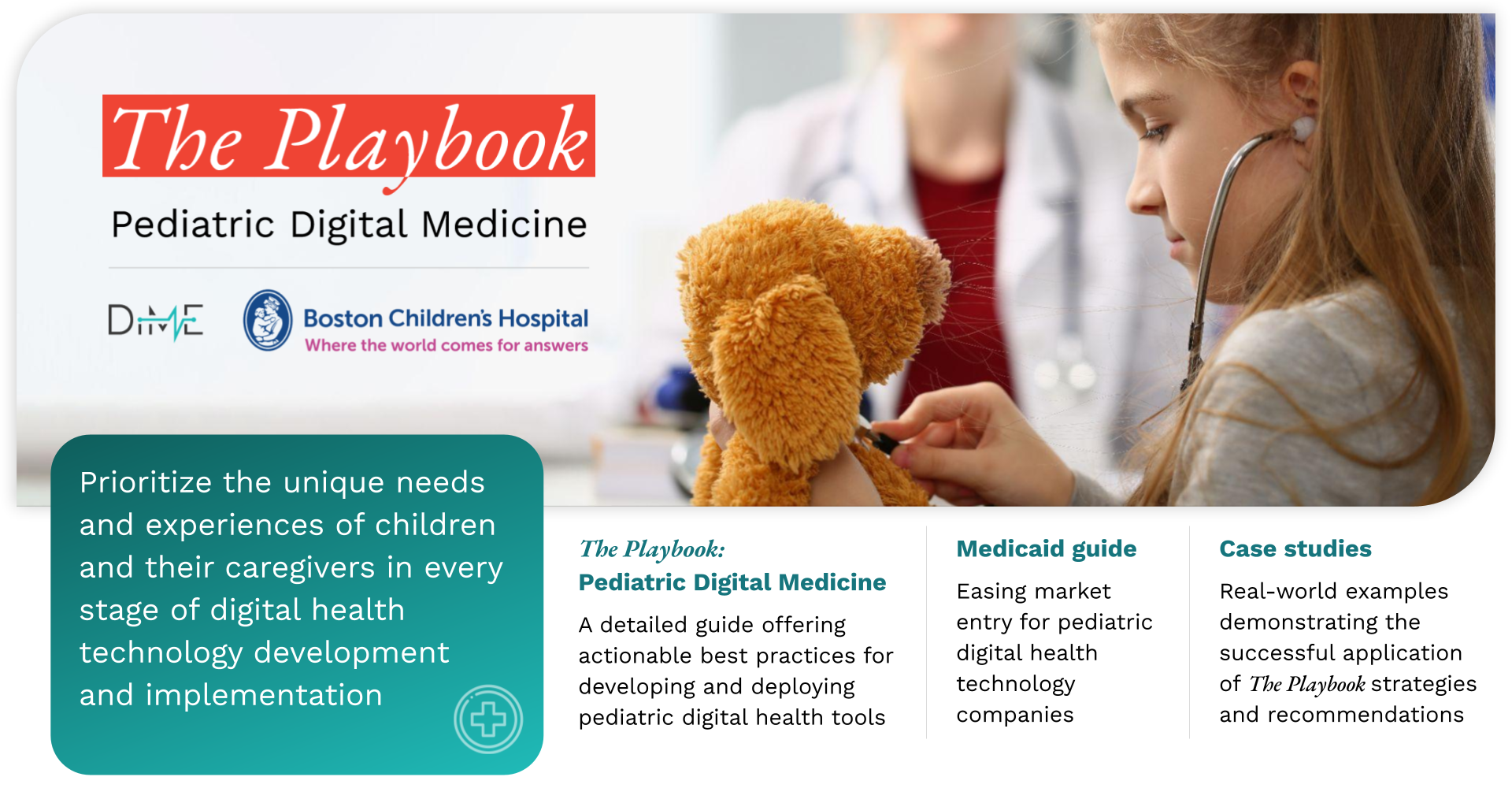
The Playbook is our testament to the belief that if we want better outcomes for children, we need systems designed for them.
A critical step forward from CMS
That is why it is so encouraging to see the launch of the Accelerating State Pediatric Innovation Readiness and Effectiveness (ASPIRE) Model last week by the Centers for Medicare & Medicaid Services.
ASPIRE is focused on improving care for children in Medicaid and CHIP by integrating physical, behavioral, and social care, creating accountability for outcomes and cost, and reducing the burden on families navigating fragmented systems.
As outlined by Mehmet Oz, M.D., Administrator of the Centers for Medicare and Medicaid Services and Abe Sutton, Director of the Center for Medicare and Medicaid Innovation, ASPIRE recognizes that today’s system too often leaves families to coordinate care on their own, with predictable consequences for outcomes and cost.
The Playbook supports ASPIRE implementation
ASPIRE defines a clear set of requirements to help reimagine pediatric care in the United States. The Playbook offers practical, actionable guidance for the digital infrastructure, care coordination models, and measurement systems ASPIRE envisions
Turning whole-child care into an operational model
ASPIRE requires states and participating entities to deliver integrated, whole-child care across physical health, behavioral health, and social services, with coordination across providers, schools, and community organizations.
The Playbook translates this into specific, buildable care models, outlining how digital tools support longitudinal monitoring and more personalized care planning. It moves integration from aspiration to execution, covering how DHTs can be deployed across clinical, home, school, and community settings, and how to align digital tools with the multidisciplinary care teams and phased implementation strategies that whole-child coordination requires.
Enabling measurement for value-based payment
ASPIRE ties participation to outcomes and total cost of care, requiring states to define meaningful pediatric outcomes and track improvement over time.
The Playbook provides practical guidance on pediatric measurement, including digital endpoints, caregiver-reported outcomes, and passive data streams. It enables teams to define what they will measure and how those measures support accountability.
Identifying rising-risk children earlier
ASPIRE includes children who are not yet high-cost but are at risk of becoming so, requiring earlier identification and intervention.
The Playbook addresses the shift from episodic to preventive, data-driven care, including how DHTs enable continuous monitoring and early detection of chronic conditions in children, supporting the proactive, population-level identification that ASPIRE envisions.
Designing for families, not systems
ASPIRE aims to reduce the burden on families navigating fragmented care.
The Playbook provides guidance on caregiver-facing tools, communication workflows, and consent and assent as children age. It helps ensure that systems are usable and trusted by families, not just compliant with program requirements.
Supporting real-world data sharing
ASPIRE depends on data sharing across fragmented systems, but does not prescribe how to achieve it.
The Playbook addresses how DHTs can streamline data collection in ways that reduce burden on children and families, enable continuous real-time monitoring, and generate richer data than traditional clinical settings alone. It also explores how real-world data and clinical research can inform each other–a foundation for the kind of cross-system data use ASPIRE will require.
Informing procurement and implementation decisions
ASPIRE requires states and organizations to select and deploy solutions quickly.
The Playbook provides decision frameworks for evaluating digital tools, assessing evidence, and aligning capabilities with pediatric needs. This supports faster, more defensible procurement and reduces the risk of fragmented or non-scalable solutions.
A moment we must build on
There are few populations more deserving of the best our healthcare system has to offer than children. And yet, for too long, they have been left behind in digital innovation.
With ASPIRE, CMS has stepped up to help establish systems that deliver the best possible care to the most vulnerable children we are responsible for.
The ASPIRE model reflects an understanding that pediatrics cannot be addressed through a simple lift-and-shift of adult approaches. Delivering better outcomes for children requires a different model of care, a different approach to measurement, and systems designed around the realities of childhood and the care systems in place to support them.
That is the work ahead. And at the DiMe, we stand ready to support it.
If you are a state Medicaid agency considering participation in ASPIRE, or a health system, payer, or developer working to improve care for children, we would welcome the opportunity to work with and support you.
Because building better systems for children is not a niche effort. It is a test of whether our healthcare system can deliver on its promise.