How Zivian Elevate is reshaping feedback in clinical care
Few professions build feedback into a career the way medicine does. Physicians train for years in residency under senior physicians who sign off on their work. Nurse practitioners (NPs) and physician assistants (PAs) often practice under collaborative or supervisory agreements required by state law. Even fully independent physicians go through peer review for as long as they practice. On paper, clinicians are never far from someone reviewing their work.
Reviewing someone’s work and helping them improve are different things, though, and right now, health care often treats them as one and the same. Much of today’s oversight exists to satisfy a regulator or an accreditor by reviews getting completed, logged, and filed. When results do reach the clinician, they often arrive as a row of scores tied to an encounter ID, with little explanation of what the reviewer saw or what to do differently. The learning structure is in place, but too often the learning itself gets lost.
Zivian Health has watched this play out from the inside. The organization has spent years helping clients manage NP and PA oversight across state lines, yet customers kept asking for help simply to get chart reviews done. Zivian’s answer is Zivian Elevate, which treats each review as a chance to coach rather than a compliance task. How the team built it, and what it learned along the way, offers lessons for anyone working on clinical quality, workforce growth, or the responsible use of AI in care.
Oversight that runs in silos
Clinical oversight serves several purposes at once. It satisfies state regulations and accreditation standards. It supports internal quality programs. It also helps train and retain clinicians. Hospitals, for example, follow Joint Commission standards that call for Ongoing Professional Practice Evaluation (OPPE) and Focused Professional Practice Evaluation (FPPE), which are structured reviews of a clinician’s performance. Many other care settings model their own oversight on those standards.
The trouble is that each process tends to live in its own silo. Jaclyn Miller, Chief Product Officer at Zivian, described a landscape where compliance tracking, quality review, and coaching happen in separate places, often in spreadsheets, with little connection between them. Pulling them into one view, she said, creates a large efficiency gain and makes it far easier to give clinicians useful feedback.
The cost of the current approach is high. Zivian estimates that the health care industry spends roughly $240 billion a year on tasks that are clinical in nature but administrative in practice. And the burden falls disproportionately on back-office teams: a 2016 Health Affairs study found that more than 80% of the time practices spent on quality reporting is handled by non-physician staff rather than clinicians.
“The remaining 20% or so lands on physicians, NPs, and PAs themselves. This manual tracking work is one of many contributors to clinician burnout and job dissatisfaction.”
– Griffin Mulcahey, CEO, Zivian

Complexity adds to the strain. When Zivian’s customers asked for direct guidance on their oversight obligations, the honest answer was often “it depends.” Requirements shift based on patient population, level of care, what a clinician prescribes, and which states they practice in. An NP working in telehealth across many states might receive feedback from five supervising physicians, a clinical operations manager, and a direct manager. Conflicting guidance is a predictable result.
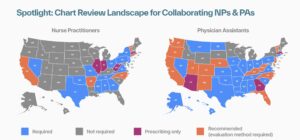
Source: Zivian, Scaling Chart Review for the Modern Clinical Workforce
From “it depends” to clarity
The idea of Elevate started with customer requests. Organizations kept asking Zivian for help completing chart reviews, and over time Zivian gathered enough data to answer questions that once had no simple answer. As Miller put it, the company reached a point where it could say, “Yep, we got it,” and handle the complexity on the customer’s behalf.
The review process in Elevate follows a clear sequence:
- Connection. Elevate connects to the EHR and pulls what the customer’s review program requires (charts, notes, labs, prescriptions, etc.). Zivian custom configures sampling and review workflows to the customer’s internal bylaws/policies, regulations, and care specialties.
- Elevate runs the review cycle. Elevate AI automates the admin work of chart review cycles — chart sampling, reviewer assignment, reminders, and adverse events review.
- AI pre-audit. Before a supervisor opens the chart, Elevate’s AI reviews it. It checks whether the clinician considered and ruled in or out the “must not miss” diagnoses, then scores areas such as documentation, treatment plan and safety, and medication management, along with specialty-specific items.
- Supervisor review. The supervising clinician sees exactly where the AI looked in the chart, with every finding linked and cited. The AI never completes an audit on its own. A human reviewer makes the final call and adds their own comments.
- Clear, specific feedback. For each gap, the output states what would have needed to change for a perfect score. Elevate rolls all reviews into one summary per clinician.
- One full view of workforce performance. Every review becomes structured data, and clinical leadership sees a longitudinal performance record across the workforce, by clinician, specialty, and site. The record builds with every cycle.
That summary starts with strengths. It then names “fair” areas, which are opportunities to grow, and finally calls out anything that needs immediate attention. Clinicians can always trace a score back to the chart and to the reviewer’s comments. Zivian designed the summary with a busy clinician in mind. As Miller noted, “NPs and PAs have about 15 minutes to read their feedback, understand it, and get back to seeing patients.”
Better mentors, not just faster reviews
Speed is the obvious benefit of automating chart review, and cost follows close behind. Zivian reports that a chart reviewed through Elevate costs about $1, compared with roughly $13 for a manual program. That difference speaks directly to the administrative burden described earlier, which falls on back-office teams and clinicians alike. Still, the more interesting lesson from Zivian Elevate is about the quality of feedback.
Giving good clinical feedback is a skill, and not every experienced clinician has had the chance to build it. Some reviewers mark everything green to avoid hard conversations. Others focus only on what went wrong. This leaves the clinician without a clear path forward. Elevate’s structured output gives supervisors a consistent starting point every time. They see many examples of what strong feedback looks like, which frees them to spend their own comments on context and coaching that a template cannot provide.
“The physicians using Elevate rarely lead with the time savings. What they value most is that the tool helps them give better feedback to the NPs and PAs they oversee.”
– Jaclyn Miller, Chief Product Officer, Zivian

On the NP and PA side, the early theme is transparency. When a clinician can see exactly how a reviewer reached a conclusion, the follow-up conversation becomes concrete and actionable. Miller offered an example. A clinician might have correctly ruled out a head trauma concern for a patient but never documented that reasoning. With clear feedback, the clinician and supervisor can recognize a documentation gap rather than a care plan problem and agree together on a specific fix.
“When you’re managing a clinical workforce at scale, staying compliant comes down to having a tool that gives you a window into what’s actually happening.
Our old process was manual and difficult to track, but with Elevate everyone now grades against the same standard, which gives us an objective view of our clinicians’ work and helps us identify who needs support faster. For the first time, our compliance, legal, and medical leadership have a window into our chart review that we didn’t have before.”
– Pamela Reid, Senior Director of Compliance, CRH Healthcare
CRH Healthcare, a multi-state urgent care organization, recently adopted Elevate to bring consistency and visibility to clinical chart review across its workforce. Before Elevate, its compliance and clinical leadership managed chart review with manual workflows that were difficult to track across states.

Building trust with AI in the loop
Much of the public conversation about AI in health care centers on fear of replacement. Zivian’s experience points to a different question: did the old process treat clinicians as people in the first place?
Miller argued that oversight had felt impersonal well before AI arrived. A clinician might receive a spreadsheet of scores tied to a patient number and an encounter ID, with no context about the chart or what the reviewer was thinking. In her words, you become “one number amongst many on a spreadsheet.” Linked citations and plain-language feedback give that context back.
Trust still has to be earned, and Zivian’s approach offers a practical model for others deploying AI in clinical settings:
- Bring clinical leaders in early. Administrative teams may want AI to take on as much work as possible. Zivian involves clinical management from the start, because they define what good care looks like.
- Design the quality program first. Implementation begins with each customer’s existing quality program. Zivian helps them decide what to evaluate and what they want the AI to focus on.
- Tune the AI to local practice. Each organization has its own protocols, patient populations, and expectations. The AI is adjusted to fit them.
- Start small, then expand. A pilot group goes first. Their feedback shapes the next round, and early enthusiasm helps build support across the organization.
- Always disclose AI use. Elevate marks clearly when AI is on, including for simple summaries, so reviewers and clinicians always know what they are looking at.
One advantage came from the compliance world itself. Oversight reviews already happen on a set schedule, whether weekly, monthly, or quarterly. That rhythm gives organizations a natural cycle to test, learn, and improve the AI over time.
Where the feedback loop goes next
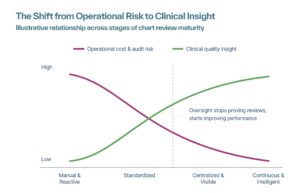
Source: Zivian, Scaling Chart Review for the Modern Clinical Workforce
The need reaches well beyond NP and PA oversight. A few years ago, a large health system with about 8,000 physicians came to Zivian looking for software to run its annual physician peer review. Zivian was not ready to take that on then, but the request stayed with the team. More recently, other health systems have reached out on their own, saying existing options didn’t meet their needs or cost too much. Zivian had not yet marketed this use case when those inquiries arrived.
Zivian also sees potential on the payer side. Health insurers review large volumes of charts for utilization management, which is the process of checking whether care is appropriate and covered. They also review charts to meet quality requirements for Medicare Advantage plans and accountable care organizations (ACOs), which are groups of providers that share responsibility for a patient population’s cost and quality. Much of that work is rule-based and still done by hand.
Mulcahey described two goals behind Elevate. The first is to help organizations bring the cost of compliance close to zero. The second, which he credited to Zivian’s founder, is to restore a fast, clear performance feedback loop. In his view, that loop is how clinicians get better, and it has largely been missing.
That second goal brings the story back to where it started. Medicine already surrounds clinicians with review, and the structure for learning has been there all along. What Zivian is working to restore is the piece that went missing: feedback a clinician can understand, trust, and act on before seeing the next patient.